
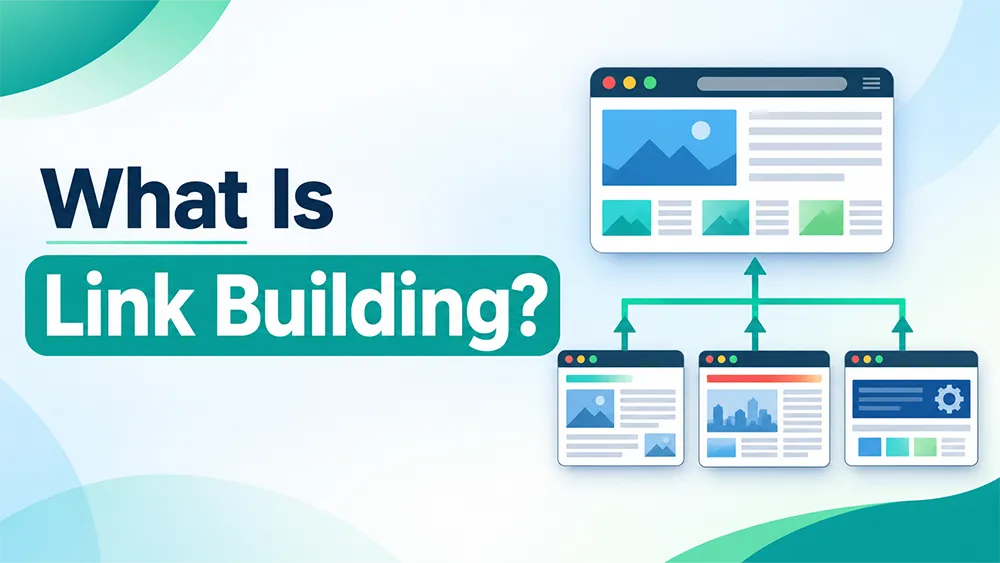
If you want to understand what is link building and why it matters for SEO, start with the role backlinks play in helping search engines discover and evaluate websites. Link building is the process of acquiring links from other websites to your own. When relevant, trustworthy websites link to your content, they can help strengthen your site’s credibility, improve its visibility in search results, and attract visitors who are interested in what you offer.
However, successful link building involves more than collecting as many backlinks as possible. It requires useful content, relevant website relationships, thoughtful outreach, and consistent evaluation. This guide explains how link building works, the types and strategies to consider, the tools that can help, and the metrics you can use to measure its impact.
- What Is Link Building?
- Why Is Link Building Important for SEO?
- Types of Link Building
- Evaluating Link Quality vs. Quantity
- Core Link Building Strategies
- Major Link Building Tools
- Common Link Building Mistakes to Avoid
- Key Metrics to Measure Link Building Success
- Final Thoughts on Link Building
- Need an SEO Agency for Link Building Solutions?
- Frequently Asked Questions
What Is Link Building?
Link building is an SEO practice that involves earning or acquiring hyperlinks from external websites to pages on your website. These links, commonly called backlinks, allow users to navigate between websites and help search engines discover pages and understand how online content is connected.
A backlink can serve as a reference to a useful resource, a citation for original research, or a recommendation for a product or service. Links from relevant websites with strong editorial standards can support your site’s reputation and organic search performance. Their value depends on factors such as relevance, context, and how naturally the link fits within the referring page.
The goal is not simply to increase the number of links pointing to your website. It is to build a backlink profile that supports your content, audience, and wider SEO objectives.
Why Is Link Building Important for SEO?
A healthy backlink profile serves as a fundamental pillar of modern organic search success.
Helps Improve Search Engine Rankings
Relevant backlinks contribute directly to search rankings by serving as major off-page signals alongside content quality, technical site health, and user experience metrics. Search engine algorithms analyze the quality and context of incoming links to determine where a page should rank in competitive search results.
Builds Website Authority and Credibility
Editorial links from relevant, trustworthy websites strengthen your domain reputation. When respected industry publications point to your pages, search engines view your site as an authoritative source of information.
Helps Search Engines Discover Content
Search engine spiders follow links to crawl the web efficiently. Acquiring backlinks from frequently crawled websites helps search engines discover your new pages much faster and accurately map topic relationships across your site hierarchy.
Drives Referral Traffic
Backlinks bring relevant visitors directly from other web properties to your site. This referral traffic consists of qualified users who are already engaged with the referring site’s content and are likely to interact with your offerings.
Strengthens Topical Relevance
Links from topically related websites provide crucial context about your content. When industry-specific publications link to your articles, search engines gain a clearer understanding of your core subject matter expertise.
Supports Long-Term Organic Visibility
Sustainable backlink growth complements technical SEO, on-page optimization, and ongoing content marketing. Together, these integrated efforts create a durable competitive advantage that sustains organic search performance over extended periods.
Types of Link Building
Link building can be classified according to how links are acquired and whether the methods follow search engine guidelines.
Natural Link Building
Natural link building happens organically when third-party websites discover your content and cite it as a source without any direct promotion or outreach. These links represent genuine editorial endorsements driven entirely by the value, accuracy, and utility of your published material.
Manual Link Building
Manual link building involves actively seeking backlinks through personalized email outreach, content pitches, and relationship-building campaigns. This structured approach allows you to target specific industry publications, resource directories, and editorial partners to secure high-value placements.
Self-Created Link Building
Self-created link building includes adding links to business profiles, user forums, blog comments, social bookmarks, and online directories. These links must always serve a genuine business purpose and help users navigate to useful information, rather than existing purely as artificial attempts to manipulate search engine rankings.
White-Hat Link Building
White-hat methodologies prioritize valuable content creation, authentic publisher relationships, and strict compliance with search engine spam policies. These ethical strategies focus on earning natural editorial links that deliver sustainable SEO value without risking algorithmic penalties.
Black-Hat Link Building
Black-hat link building relies on manipulative tactics designed to deceive search algorithms. Methods such as buying links, participating in automated link creation schemes, and leveraging private blog networks carry severe SEO risks, including manual search penalties and permanent algorithmic demotions.
Grey-hat link building falls between these two approaches, utilizing tactics that test the boundary of search engine guidelines without explicitly crossing into flagrant spam. Focusing on white-hat practices remains the safest route for long-term brand protection.
Evaluating Link Quality vs. Quantity
Evaluating a backlink profile requires looking beyond total link count to analyze the relevance, context, and editorial quality of every incoming connection.
Relevance of the Linking Website
Links from websites covering topics directly related to your niche carry far more weight than links from completely unrelated domains. Search engines analyze topical alignment between the referring page and the target URL to establish contextual trust.
Authority and Credibility of the Website
A referring site’s reputation, editorial standards, and audience trust impact the value of its links. Third-party metrics like Domain Authority and Domain Rating offer helpful comparative benchmarks, but they should always be evaluated alongside manual reviews of the site’s real-world publishing standards.
Context and Placement of Backlinks
Contextual links placed within the primary body text of a relevant article pass significantly more value than links hidden in sidebars, sitewide footers, or author bio boxes. The surrounding text provides vital context to both users and search crawlers.
Anchor Text Relevance
Descriptive anchor text gives users and search engines explicit clues about the destination page’s content. While natural anchor text variation is healthy, over-optimizing with excessive exact-match keyword anchors can trigger manipulative link filters.
Referring Domains vs. Total Backlinks
Referring domains measure the number of unique websites pointing to your domain. Securing ten links from ten different authoritative websites provides much stronger ranking signals than receiving one hundred links from a single domain footer.
Dofollow vs. Nofollow Links
Standard dofollow links allow search engine crawlers to pass authority and ranking signals to the destination URL. Conversely, links tagged with the rel=”nofollow” attribute instruct search engines not to pass authority. Additional attributes include rel=”sponsored” for paid placements and rel=”ugc” for user-generated content, helping search engines categorize link intent accurately.
Identifying Low-Quality Backlinks
Low-quality backlinks originate from spammy directories, automated comment sections, or irrelevant link networks. A low third-party authority score alone does not mean a backlink is harmful. True harm stems from manipulative intent and unnatural site patterns, not simply smaller or newer websites.
For more details on how Google treats these link attributes and when to use them, refer to Google’s guide on qualifying outbound links.
Core Link Building Strategies
Executing successful campaigns requires implementing proven, sustainable outreach methodologies.
1 Content-Based Link Building
Content-based link building relies on creating exceptional web assets that serve as authoritative references for other publishers:
- Create original research, industry reports, surveys, and data-driven studies that journalists frequently cite.
- Publish comprehensive guides and detailed educational resources that answer complex industry questions.
- Develop interactive tools, visual infographics, free templates, and calculators that provide immediate utility.
- Promote your useful assets directly to relevant publishers, bloggers, and webmasters across your sector.
2 Guest Blogging
Contributing expert articles to established publications allows you to reach new audiences while securing contextual mentions:
- Identify relevant websites in your industry that accept external guest contributions.
- Pitch original, highly engaging topics that align directly with the publication’s editorial standards and audience interest.
- Contribute thoroughly researched articles containing helpful links where editorially appropriate.
3 Digital PR and Media Outreach
Digital PR focuses on earning coverage from journalists, major news outlets, and top-tier trade publications:
- Share original research data, proprietary statistics, and expert commentary directly with journalists.
- Respond promptly to media requests for expert quotes on platforms like Connectively or Qwoted.
- Develop creative campaigns and newsworthy stories that attract organic media coverage and authoritative press links.
4 Broken Link Building
This tactical strategy helps webmasters fix broken outbound links on their sites while gaining a replacement placement for your content:
- Find broken external links on topically relevant resource pages using specialized SEO crawler tools.
- Create or identify a high-quality piece of content on your site that serves as an exact replacement.
- Contact the webmaster politely to report the broken link and suggest your active resource as a seamless fix.
5 Competitor Backlink Analysis
Analyzing your primary competitors’ link profiles highlights proven strategies and reveals untapped outreach targets:
- Analyze competitors’ backlink profiles using specialized backlink tools to uncover their top link sources.
- Identify recurring domain intersections where multiple competitors have secured placements.
- Target those same high-value resource pages, media directories, and industry blogs with tailored outreach pitches.
- Develop content and outreach plans to pursue suitable opportunities systematically.
6 Resource Page Link Building
Many websites maintain curated resource lists designed to connect their readers with helpful external tools and references:
- Find industry resource pages, curated reference hubs, and recommended reading lists using advanced search operators.
- Evaluate whether your content adds genuine, distinct value to the existing list of resources.
- Contact the page owner with a clear, concise pitch explaining how your resource enhances their curated page.
7 Unlinked Brand Mention Link Building
Websites often mention established brands, key executives, or proprietary products without adding a clickable hyperlink:
- Find online publications that mention your business, brand name, or spokespeople without linking back to your domain.
- Identify relevant mentions where adding a functional hyperlink improves user experience.
- Reach out to the author or editorial team with a friendly request to convert the plain text into a live reference.
8 Link Reclamation
Link reclamation focuses on recovering lost link equity resulting from site updates, page deletions, or URL structural changes:
- Identify lost backlinks and incoming links that currently point to broken 404 pages on your domain.
- Restore deleted pages or set up clean 301 redirects to point outdated URLs to their closest active equivalents.
- Contact publishers to update broken or incorrect destination URLs directly on their pages.
9 Business and Local Link Building
Local organizations can build geographic authority by securing links from community partners and regional directories:
- Obtain accurate business listings from reputable local business directories and regional industry associations.
- Build active relationships with local non-profits, community groups, and business chambers.
- Participate in relevant local events, charity sponsorships, and community initiatives that earn genuine mentions.
- Seek news coverage from regional newspapers, local podcasts, and community blogs.
10 Influencer and Industry Relationship Building
Cultivating long-term professional relationships with industry creators leads to natural, recurring link opportunities over time:
- Connect with respected industry experts, content creators, and digital publishers across social channels.
- Collaborate on co-authored expert roundups, detailed interviews, or joint research projects.
- Build genuine professional relationships that naturally result in ongoing editorial mentions and organic references.
11 Link Exchange and Partnership Opportunities
Strategic partnerships with non-competing businesses can expand your reach when executed ethically:
- Identify businesses with complementary audiences, such as a web design agency partnering with a copywriter.
- Develop genuine joint collaborations, such as co-branded industry reports or shared educational webinars.
- Avoid excessive reciprocal link trading or artificial link exchanges designed solely to manipulate search engine rankings.
12 Forum and Community Engagement
Participating in active community discussions helps establish personal authority and drives targeted referral traffic:
- Participate regularly in relevant professional subreddits, Quora threads, and niche discussion forums.
- Answer user questions thoroughly with useful, insightful responses that demonstrate real expertise.
- Share links to your content sparingly, only when doing so directly solves a user’s problem and adheres to platform rules.
For a deeper look at these approaches, explore additional link building strategies that can help you earn quality backlinks and strengthen your website’s search visibility.
Major Link Building Tools
Leveraging specialized software platforms streamlines link prospecting, competitive auditing, and performance tracking.
Google Search Console (GSC)
Google Search Console provides first-party data directly from Google regarding how its crawler views your link profile. You can review top linked pages, examine referring domains, and monitor overall organic search performance. While GSC offers accurate sample data, it operates with limitations as it does not display every backlink pointing to your site.
Google Analytics 4 (GA4)
Google Analytics 4 allows you to measure the real-world business impact of your backlink acquisition campaigns. By tracking referral traffic, user engagement metrics, and goal conversions from external sites, GA4 highlights which referring sources deliver valuable, high-converting visitors.
Ahrefs
Ahrefs features one of the largest web crawler databases in the industry, making it an essential tool for backlink analysis. Marketers use it to research competitor backlink profiles, uncover broken links across the web, review historical anchor text distributions, and monitor overall referring domain growth over time.
Semrush
Semrush provides a robust suite of tools designed for competitive backlink research and backlink profile auditing. Its built-in outreach module helps manage prospecting pipelines, execute email sequences, and audit link profiles to detect manipulative link patterns.
Moz Pro
Moz Pro offers Link Explorer, a reliable tool for evaluating backlink profiles and identifying link opportunities. Moz established the widely recognized Domain Authority (DA) and Page Authority (PA) comparative metrics, which help SEO professionals gauge domain strength relative to competitors.
Common Link Building Mistakes to Avoid
Avoiding shortcuts and manipulative tactics is crucial to protecting your site from search penalties.
Prioritizing Quantity Over Quality
Chasing raw link counts without evaluating domain relevance or editorial standards is an unreliable SEO strategy. A few contextual links from respected industry sites deliver far more value than hundreds of spam links.
Buying Links to Manipulate Rankings
Purchasing links explicitly intended to pass ranking credit directly violates Google’s search spam policies. Paid link schemes can lead to manual action penalties or automated algorithmic demotions that destroy organic visibility.
Using Private Blog Networks
Private Blog Networks (PBNs) are networks of sites created solely to pass link equity to target domains. Search engines systematically identify and penalize these artificial networks, stripping away all unnatural link value.
Overusing Exact-Match Anchor Text
Repetitively forcing exact-match commercial keywords into your anchor text creates an unnatural backlink profile. This pattern alerts search algorithms to potential link manipulation, increasing your penalty risk.
Building Links from Irrelevant Websites
Acquiring links from sites that share no topical connection with your business dilutes your contextual signals. Search engines value relevance above all else when evaluating incoming links.
Relying on Low-Quality Directories
Submitting your site to automated, low-quality web directories provides no real value and creates spammy link patterns. Focus exclusively on legitimate, vetted local and industry business directories.
Sending Generic Outreach Emails
Sending unpersonalized, templated outreach emails to thousands of publishers leads to low response rates and damages your brand reputation. Effective outreach relies on personalized messaging and clear value propositions.
Ignoring Existing and Lost Backlinks
Failing to monitor your existing backlink profile results in lost link equity over time. Regularly auditing your site allows you to recover broken links and maintain your earned authority.
Expecting Immediate Results
Link acquisition and observable ranking improvements require consistent, sustained effort over time. Search algorithms process new links gradually, meaning SEO results unfold over weeks and months rather than days.
Key Metrics to Measure Link Building Success
Measuring success requires looking beyond raw links to evaluate organic traffic growth, referral quality, and business returns.
Number of New Backlinks
Track the number of new backlinks your website acquires over a specific period to monitor link building progress. Review the quality and relevance of these links alongside the total count.
Number of Referring Domains
Measure how many unique websites link to your website. A growing number of relevant referring domains can indicate that your content is attracting attention from a wider range of sources.
Backlink Quality and Relevance
Evaluate backlinks based on the credibility of the referring website, topical relevance, and link placement. Relevant editorial links can be more valuable than large numbers of unrelated links.
Organic Traffic and Keyword Visibility
Monitor organic traffic, search impressions, clicks, and keyword rankings to identify changes in search performance. Consider other SEO activities and external factors before attributing improvements directly to link building.
Referral Traffic
Track the visitors who reach your website by clicking backlinks on other websites. This helps identify which referring sources attract relevant audiences and encourage further engagement.
Conversions and Leads
Measure actions such as form submissions, enquiries, registrations, and purchases generated by website visitors. These metrics help you understand whether link building contributes to meaningful business outcomes.
New and Lost Backlinks
Monitor newly acquired backlinks and links that have disappeared over time. Investigate lost links to identify broken URLs, removed references, or opportunities to recover valuable backlinks.
Link Building ROI
Compare the costs of link building activities with the results they generate, including referral traffic, qualified leads, sales, and organic performance. This helps determine whether your investment supports your business goals.
Final Thoughts on Link Building
Link building remains an important part of a comprehensive SEO strategy when it focuses on relevance, useful content, and genuine editorial relationships. Relevant backlinks can help search engines discover pages, support organic visibility, strengthen credibility, and introduce your business to new audiences.
The most effective approach is to create resources worth referencing, identify suitable publishers, and build relationships based on mutual value. Monitor backlink quality, follow search engine spam policies, and measure results against meaningful business objectives. Consistency and sound judgment are more valuable than chasing a high backlink count.
Need an SEO Agency for Link Building Solutions?
Pulse SEO is a reliable SEO agency in Mumbai, helping businesses strengthen organic visibility through strategic SEO and relevant link building. Our team focuses on building quality backlinks that support your website’s authority, search rankings, and long-term organic growth. Get your free quote to discuss your website’s needs and identify practical opportunities to improve search performance.
Frequently Asked Questions
Here are answers to common questions about link building costs, timelines, and campaign expectations.
How much does link building cost?
The cost of executing a campaign varies based on your chosen strategy, industry competitiveness, and whether you manage outreach internally or partner with a specialized agency. Monthly retainers for professional agency services typically range from moderate investments for local businesses to significant monthly budgets for competitive enterprise brands. Key cost factors include high-quality content production, proprietary data research, specialized tool subscriptions, and dedicated outreach labor.
How long does link building take to show results?
Search engine crawlers may discover and index a new backlink within a few days or weeks of its publication. However, observing measurable ranking improvements and organic traffic growth usually takes between 3 to 6 months of consistent effort. The exact timeline depends heavily on your domain’s existing authority, the competitiveness of your target keywords, content quality, and the overall relevance of acquired links.